Saturday, July 01, 2006


Karrin and Nancy's rainy day

My wife and I went to a jazz festival in Toledo on June 18, mainly so that I could see my favorite jazz singer, Karrin Allyson. Unfortunately, it was a stormy day, and Karrin Allyson's performance had to be cut short after just six songs. The performance was supposed to also feature Nancy King, a jazz singer who performs with Allyson on Allyson's great new album, "Footprints," but the storm began before King could participate.

That was kind of a bummer, but there was a nice incident later. While the headliner, Al Jarreau, was performing, I noticed Karrin Allyson standing off to the side of the stage with another woman. I walked over to try to get a picture. I didn't know who Nancy King was until "Footprints" came out, but when I got my copy I looked King up on the Internet, and I noticed the woman next to Karrin looked like the picture I'd seen. She was closest to the fence I was behind, so I asked her, "Are you Nancy King?" She was, and when I explained how I'd figured out who she was, she asked, "Did you look at my web site?" I explained I'd just found out who she was but that I planned to track down her music, too. She suggested I pick up her new album with Fred Hersch, "Live at Jazz Standard."

I asked if I could take her picture, and she asked if I wanted Karrin Allyson in the picture, too, and I said sure, so she grabbed her friend and they posed for me. That's Nancy on the left and Karrin on the right. I got to talk to Karrin Allyson, too, and asked her to come back to Ohio, and she asked my name and shook hands.

It turned out my favorite music downloading site, eMusic, had "Live at the Jazz Standard," so I bought it. The same site also has the entire Karrin Allyson catalog.

Sunday, May 28, 2006

My Utopia

I recently wrote a column for my paper outlining the changes I would make if I could somehow become dictator and impose all of the laws I want.

My favorite part was this: "Due space will be provided in public libraries and college literature courses for our greatest living literary geniuses -- Neal Stephenson, Susanna Clarke, Robert Anton Wilson, Iain Banks, Elinor Lipman and Tom Perotta." My dad didn't recognize the names but looked them up on the Internet and discovered I was referring to real authors.

The rule that got the most comment though, was requiring all women to wear red clothes at least once a week. (I just like the way women look in red.) A few days after the column was published, I covered a meeting of the county commissioners in Erie County, Ohio, and all of the women on the third floor (of the County Services Center, where the commissioners meet) were dressed in red, including a county commissioner and the county clerk. They looked great, of course.

Column is here.

Friday, May 19, 2006

The Joe Cimperman tax

I've been reading a fascinating book called THE WAL-MART EFFECT by Charles Fishman, a business journalist, which lays out the good and bad consequences of the rapid expansion of Wal-Mart.

One undeniable effect, according to Fishman, is that Wal-Mart lowers the inflation rate in the U.S. and saves people who choose to shop there a large amount of money. Citing an academic study, Fishman asserts on Page 151 that grocery prices at Wal-Mart supercenters were found to be "on average 27 percent lower than at traditional groceries, an astonishing discount. It's like getting one week of groceries free every month, just for moving your shopping to Wal-Mart."

The pattern of Wal-Mart distribution in Cuyahoga County, where I live, is rather interesting. Democratic city officials such as Joe Cimperman have succeeded so far in blocking Wal-Mart from opening any stores in the City of Cleveland. The older suburbs have Wal-Marts. And as you get farther away from Cleveland, you are more likely to live near a supercenter, where you can save on food as well as the items that all discount stores carry. You'll also notice that Cleveland has the worst-looking neighborhoods and that the further you get away from the city, the nicer the houses look. In other words, the people who are generally better off are more likely to have access to cheaper prices for the basic goods they need to get by.

Perhaps the higher prices paid by Cleveland residents ought to be known as the "Joe Cimperman Tax," in honor of politicians who do the bidding of labor unions rather than following the best interests of their own constituents.

Tuesday, May 16, 2006

Dazed by the old radios

Radio Daze is a company that makes most of its money selling parts over the Internet and through catalogs for repairing old radios, receivers from the 1920s and 1930s and 1940s. You can't buy radios from its catalog, just parts and radio kits.

But when you visit the company's headquarters near Rochester, you can see a showroom of dozens of old radios, all for sale, which the customer can carry out the door himself or have shipped anywhere in the world. My wife bought me a 1941 table radio with both AM and shortwave bands. When we set it up in our living room and tried it, we pulled in a shortwave station from Croatia.

Tuesday, May 02, 2006

George Alec Effinger site

I've launched the George Alec Effinger pages . I've included a FAQ, links, and a blog. A bibliography will be posted soon.

Saturday, July 30, 2005

Rediscovering Philip Jose Farmer

I've been re-reading Philip Jose Farmer's "World of Tiers" books, one of his best-known series. I was a big Farmer fan in my youth. The re-reading was sparked by the discovery, in a used bookstore, that Farmer has published a sixth book in the series in the 1990s.

The books are THE MAKER OF UNIVERSES, THE GATES OF CREATION, A PRIVATE COSMOS, THE WALLS OF TERRA, THE LAVALITE WORLD and the book I found in the bookstore, MORE THAN FIRE. (For the purposes of this discussion, I'm treating RED ORC'S RAGE as a related book but not a part of the series.)

I've read the first two and I'm mostly done with the third book. The prose is creakier than I remember, and the stories are more improbable. For example, in A PRIVATE COSMOS, the hero, Kickaha, jumps on a stampeding herd of buffaloes, hopping from animal to animal. Anyone who has watched an experienced cowboy struggle to stay on top of a bull for only a few seconds at a rodeo will know how unlikely this is.

Still, the books are very imaginative and fast-moving, so I guess you have to take them as they are. The pocket universes created by Farmer's Lords (immortal humans employing "super science" are very well done. In fact, the settings are a high point of the books and enable Farmer to have fun with Plains Indian tribes, German knights, Viking marauders, Olmecs and other promising material. In some ways, these books seem to presage the Riverworld books, which I'll re-read in a few months.

Farmer is alive and well at age 87 and his Internet minions have created an official page for him that has a great deal of useful information, including a bibliography that quotes many of the reviews of his work.

A PRIVATE COSMOS features an introduction by Roger Zelazny, another of my old favorites, who does a nice appreciate of the first two "Tiers" books.

During the late 1970s, when I was a student at the University of Oklahoma, the campus science fiction club brought Zelazny in as a guest speaker, and I asked him about the introduction. He mentioned that Farmer, who he described as a bit of a hypochondriac, was worried that he would die before completing the "Tiers" series and had made Zelazy promise to finish the series, if necessary. Of course, the sad sequel to the story is that Zelazny has died since then, although it's a blessing we still have Farmer.

Wednesday, July 20, 2005

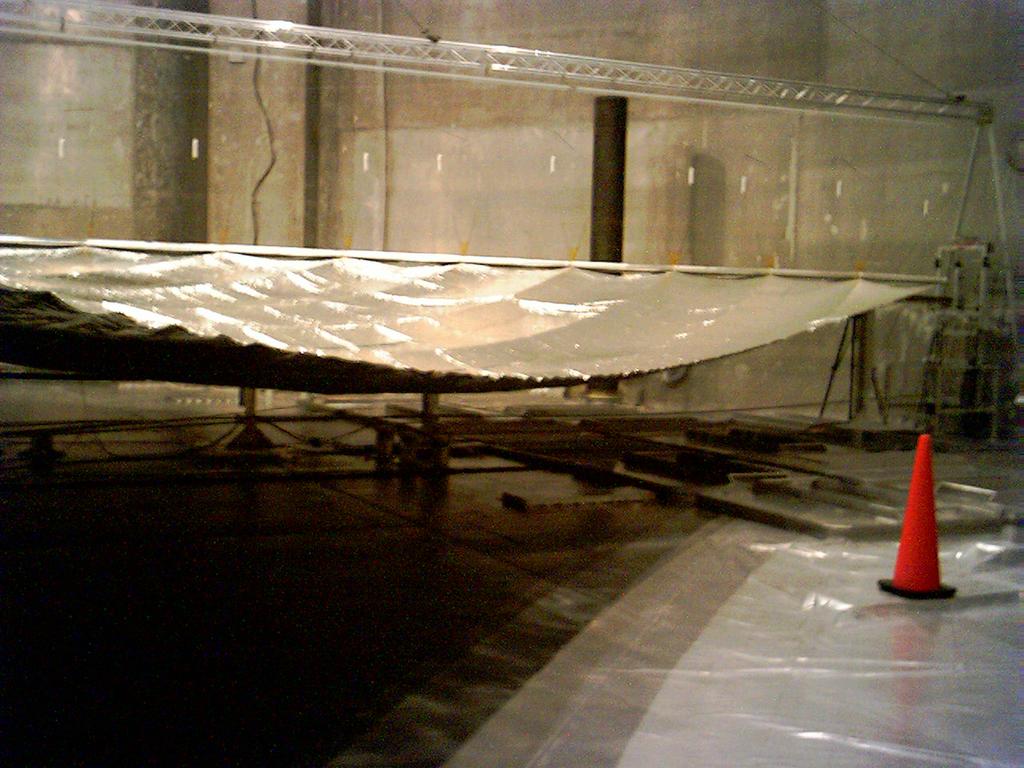
NASA tests solar sail


While my journalism career up in Cleveland has had its ups and downs, I've been fortunate to have two jobs in a row that allowed me to cover NASA, a science fiction fan's dream. Currently, I work for the Sandusky Register; part of my beat is covering NASA Plum Brook Station in Sandusky.

Plum Brook has the biggest vacuum chamber in the world, about 100 feet wide and 120 feet tall, and it's currently being used to test a prototype solar sail. A solar sail is "pushed" by sunlight and will be used someday to propel small, unmanned spacecraft.


Tuesday, July 19, 2005

My Hugo ballot

I voted for the fiction categories for the Hugo Awards -- my normal process for keeping up with what's going on -- although this time I ran out of time before I could read most of the short fiction nominees. I did read all of the novels, however, so here is how my Hugo ballot looked, with a letter grade and a few comments:

(1) Jonathan Strange & Mr. Norrell, Susanna Clarke, A+. The best novel I've read in several years. Vivid and brilliant. (2) The Algebraist, Iain Banks, A. Very good far-future space opera. Perhaps a bit like Vernor Vinge, only better written. (3) Iron Sunrise, Charles Stross, A. Cyberpunk space opera. Stross is much better than I realized. Any of these three books would do the award credit, although it would be a shame if Clarke didn't win.

(4) River of Gods, Ian McDonald, B-. This novel about Indian circa 2050 is a good novel in many ways, but I couldn't take it to heart. For one thing, I was taken aback that McDonald dislikes Indians and Hinduism so much. (5) Iron Council, China Mieville, C+. Very competently done, but I thought it was boring. Everyone should read Perdido Street Station, though, which I thought was a wonderful novel.

Sunday, July 17, 2005

New George Alec Effinger book

As a longtime science fiction fan, I worry that many of the writers I love will be forgotten soon after their deaths. It's not as if I'm an antiquarian; I love many of the current writers, such as Bruce Sterling, Neal Stephenson and Kim Stanley Robinson. But I also worry about writers I've loved for years, such as Roger Zelazny and Jack Vance, being forgotten by readers in the 21st century. I went to a science fiction convention years ago where Darrell Schweitzer, a fan, editor and writer, talked about a panel that was devoted to Jack Williamson. It was a disaster, Schweitzer said. Few people at the convention appeared to know who Williamson was. (He's a famous old SF writer who wrote a wonderful horror-science fiction novel called "Darker Than You Think.")

One of my favorites, George Alec Effinger, died in 2002, and already there is little sign that he's remembered in Cleveland, the city of his birth. Effinger was expecially good as a short story writer, and there's a new collection, "George Alec Effinger Live! From Planet Earth," which collects several of his most famous stories but also includes any stories never collected in an Effinger anthology before.